
How does Opus describe a business?

Before you rewire a business, you have to be able to describe it
Opus is where a business gets rewired. Operators map the work people do today and redesign it so that people, systems and AI agents each do the part they’re best at. But you can't rewire something until you can describe it.
Opus describes a business as four levels: streams, processes, steps, and tasks. Everything in a business fits into one of those four, and we chose each word deliberately.
The words matter more than they look. A redesign only works if everyone means the same thing by the same word. If one team's "process" is another team's "step," the gap doesn't show up while you’re planning. It shows up later, in work that was built to two different descriptions. So this post is about what each level means, why it exists, and why we use that word rather than another.
View full size.
What is a stream?
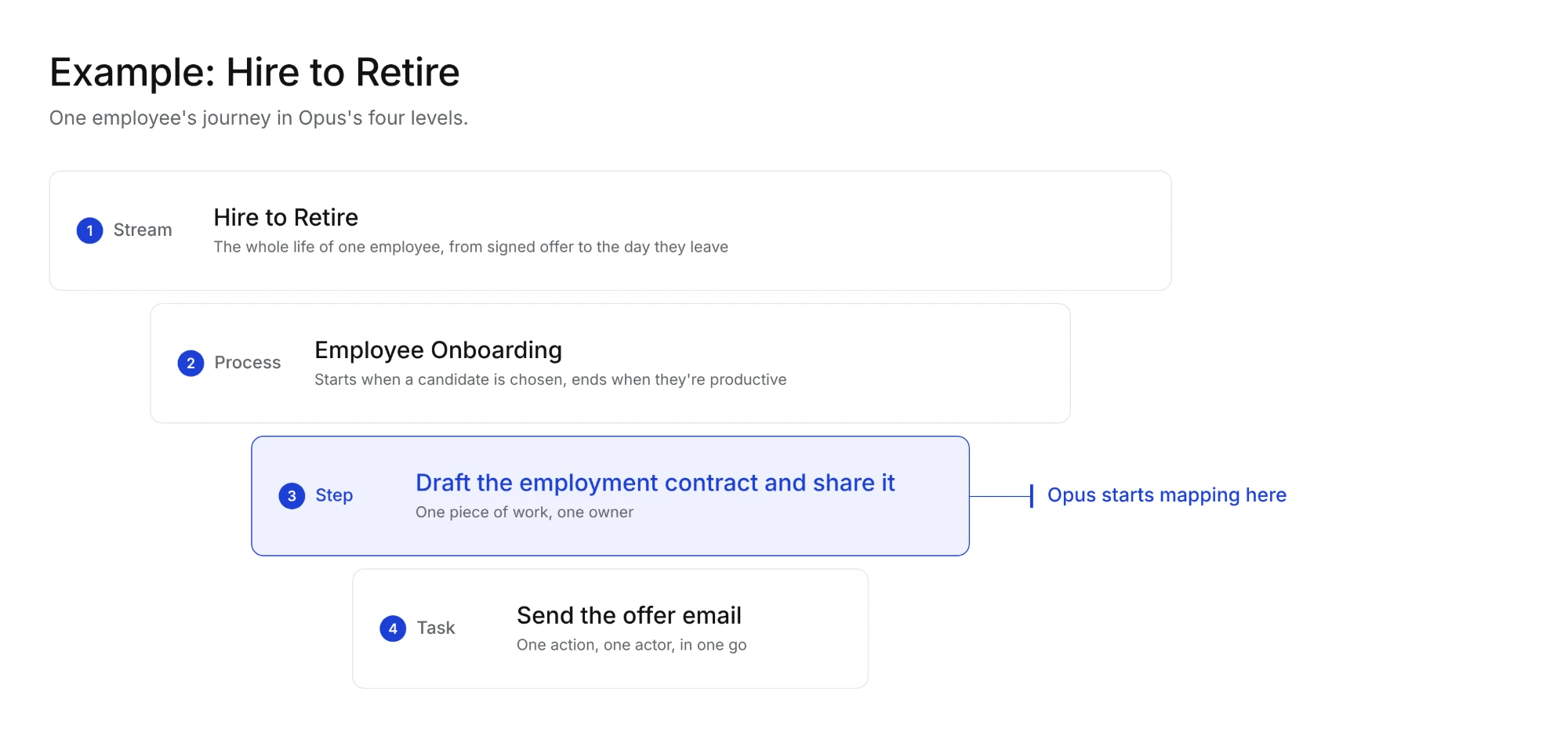
A stream is the whole life of one thing the business cares about, from start to end. Follow one employee from a signed offer to the day they leave, and everything that happens to them along the way is the stream, including the hand-offs between teams.
It exists because departments split work up, and value doesn't. A new hire doesn't care that HR, IT, finance and their manager are different teams; they just want to get from signed offer to doing useful work. Every team boundary they cross is a hand-off, and hand-offs are where work waits or gets lost. Michael Hammer said as much in 1990, in the Harvard Business Review piece that started business process reengineering: conventional process structures are "fragmented and piecemeal," and the fix is to organize around outcomes, not tasks. A stream is the view that makes the whole journey visible, hand-offs included.
Jim Womack and Dan Jones coined ‘value stream’ in their 1996 book Lean Thinking. The Lean Enterprise Institute defines a value stream as all of the actions, both value-creating and non-value-creating, required to bring a product from concept to launch or from order to delivery. We shorten it to stream, but we use it in the same spirit, and for the same reason: it's the only unit that shows the whole journey rather than one department's piece of it.
Why "stream" and not "function" or "department"? Because value flows across an organization the way water flows across land. It doesn't stop at the property lines. A function is a place; a stream is a path. If you only ever look at the places, you'll never see what happens between them, and what happens between them is usually where friction lives.
What is a process?
A process is a repeatable journey inside a stream, with a clear trigger and a clear finish. Employee Onboarding starts when a candidate is chosen and ends when they're productive. It happens the same way, more or less, every time, which is what makes it something you can improve rather than merely endure.
Why have processes at all, if you already have the stream? Because a stream is too long to own or change in one go. Hire to Retire can span thirty years. Nobody can redesign that in a quarter. A process is the biggest unit one leader can own, measure and redesign end to end. That matters because change needs an owner.
A process can contain other processes, usually called subprocesses. A subprocess isn't a different kind of thing. It's a process that happens to live inside another one.
We use the word “process” because it’s what people already say when they mean “how we reliably get this done.”
What is a step?
A step is one piece of work that moves a process toward its finish, with one owner. The owner can be a person, a team, a system or an agent. "Draft the employment contract and share it" is a step. So is "set up the laptop and accounts."
The step is where the interesting decisions get made, because a step is really a decision about who, or what, does the work. When you redesign a process, you rarely change the destination. What you change is the steps: you add one, remove one, or swap the owner from a person to a system or an AI agent. This is the level where an agent takes over work a person used to do, because the step is the unit you hand to someone. The new hire ends up with their email, payroll and system logins either way, whether someone in IT creates them or an agent does. That's why we call it a step. It's one move toward a destination, not the destination itself, and the result stays the same when you rearrange the moves.
Steps are also where people naturally describe their own work. Ask someone what they do and they won't tell you about streams. They'll tell you about steps: I get the signed offer, I raise the IT ticket, I book the induction. That turns out to matter a lot, and it's the reason Opus starts mapping here.
What is a task?
A task is one action inside a step, by one actor, in one go. "Send the offer email." "Create an email account." If a step is drafting the contract and sharing it, the tasks are pulling the template, filling in the terms, and sending the link.
Tasks exist because this is where work actually gets done, so this is where automation gets built. A task is small enough to hand to a system without ambiguity. There's no judgment call hiding inside "send the offer email"; either it went or it didn't.
We call it a task because a task is the smallest thing you can assign. Go any smaller and you're no longer describing work. You're describing how the work gets done rather than the work itself: the individual clicks a person makes on a screen, or the lines of code a system runs. Nobody assigns a click.
Why does Opus start mapping with steps?
The obvious way to describe a business is top down. Name the streams, break them into processes, break those into steps. It's tidy, and it's how APQC's framework is laid out, category first and task last. But in our experience it's not how individual employees describe their work.
We learned this with a manufacturing customer. Opus used to have an objectives level, sitting between processes and steps. On paper it made sense. In practice nobody described their work that way. When we asked people what they did, they gave us steps. Nobody mentioned an objective, so we were writing the objectives ourselves and slotting their steps underneath. So we removed it.
What people do is tell you a story, page by page. I get the signed offer. I raise the ticket. I book the induction. They don’t start with the chapter titles. The chapters only become clear once the story is told. So Opus starts with steps, which is where the knowledge actually lives, and lets the processes and streams emerge from them. The structure is discovered, not imposed. Start from the top instead and you end up describing the business you assumed, not the one people actually work in.
How does this compare to APQC?
If you've done process work before, you've probably met APQC's Process Classification Framework. It has five levels: Category, Process Group, Process, Activity and Task. APQC's own guide to the framework defines a Category as the most high-level grouping, a Process Group as a group of processes that execute a category, an Activity as a key step performed to execute a process, and a Task as an element of work that goes into executing an activity.
The four levels in Opus line up closely with APQC’s. A stream is a Category. A process is a Process. A step is an Activity. A task is a Task. That leaves APQC’s Process Group, which sits between Category and Process and means a set of related processes. We don’t give it a level of its own, because a set of related processes is just a process that contains subprocesses. So APQC’s five levels become our four.
APQC is a good common reference, and a lot of our customers think in its terms.
Why does this matter?
Follow one new hire from signed offer to productive, and you end up with a description of the work that HR, IT and the hiring manager would all recognize as true. That’s what the four words are for. You can’t rewire work that people describe differently.
Quick answers
How does Opus describe a business?
Opus describes a business with four levels: streams, processes, steps and tasks.
What is a stream in Opus?
In Opus, a stream is the whole life of one thing the business cares about, start to end, such as Hire to Retire, which follows an employee from signed offer to the day they leave. It cuts across departments and includes the hand-offs between them.
What is the difference between a step and a task in Opus?
In Opus, a step is one piece of work with one owner, such as drafting and sharing a contract. A task is one action inside a step, by one actor, in one go, such as sending the offer email. Steps are where work is assigned; tasks are where it executes and where automation is built.
How do Opus's four levels map to APQC?
An Opus stream corresponds to an APQC Category, a process to a Process (with subprocesses covering what APQC calls Process Groups), a step to an Activity, and a task to a Task.
Why does Opus start mapping at the step level?
Opus starts mapping at the step level because people describe their work step by step, not by framework. Starting with steps captures what people actually know, and the processes and streams emerge from there.