Prior authorization
TodayEvery authorization checked against criteria by hand.
OpusChecks the request against criteria, auto-approves the clear cases, and escalates the rest with an audit trail.

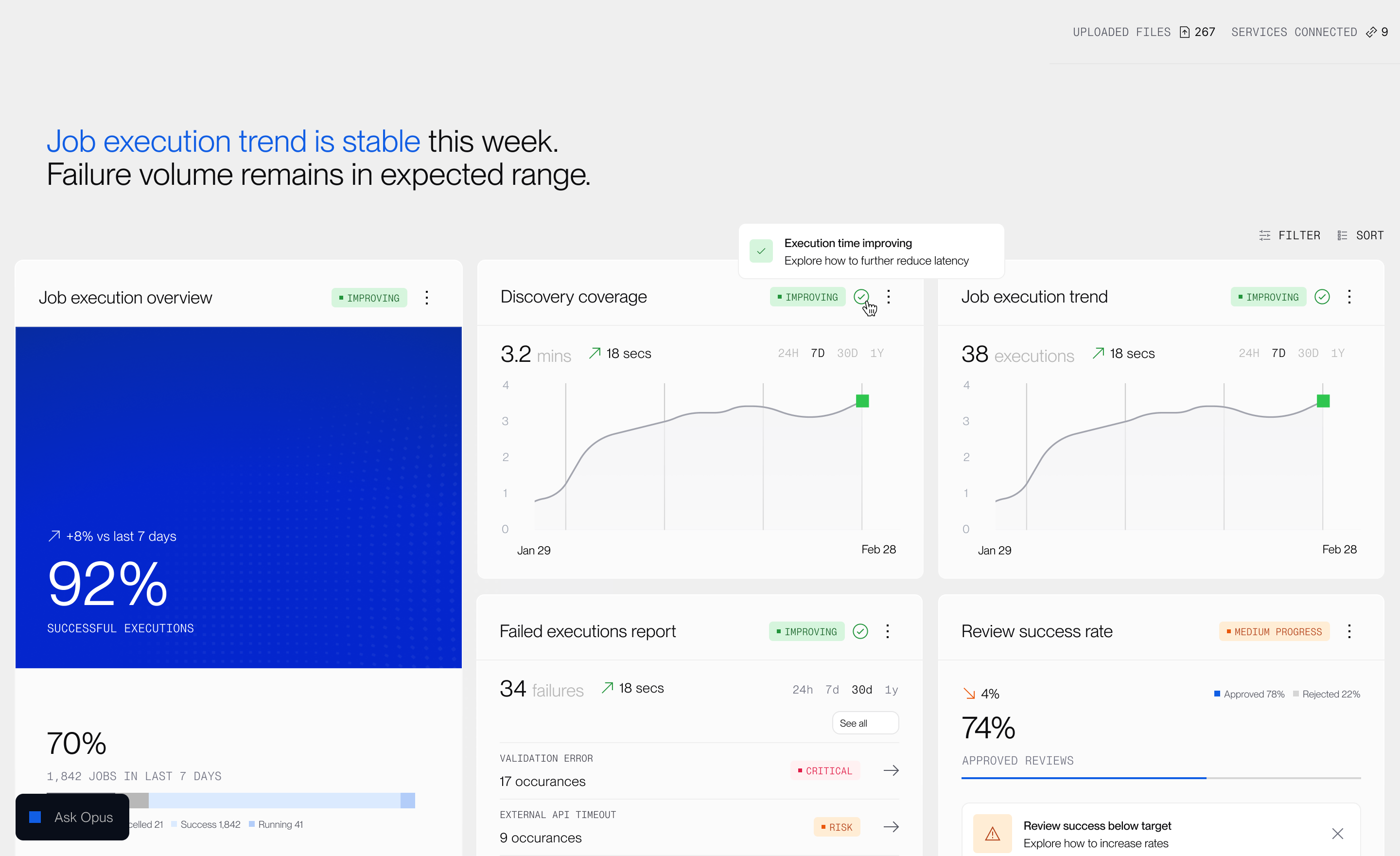
Opus builds a live model of how your claims, authorizations and member operations really run: your Digital Twin, mapped live with your clinical and claims teams. Then it puts AI to work, with a person on every decision that affects a member.

Some examples of the high-volume workflows teams hand to Opus, across claims, medical management and member operations.
TodayEvery authorization checked against criteria by hand.
OpusChecks the request against criteria, auto-approves the clear cases, and escalates the rest with an audit trail.
TodayClaims checked and coded by hand, exceptions piling up.
OpusAuto-adjudicates clean claims, flags anomalies, routes exceptions with reason codes.
TodaySuspicious billing caught late, if at all.
OpusScreens billing against peer norms, flags upcoding and duplicates, hands investigators a ready case brief.
TodayAppeals triaged and drafted by hand.
OpusClassifies each appeal, pulls the evidence, drafts a resolution letter, a reviewer signs off.
TodayApplications validated field by field.
OpusExtracts documents, validates completeness, pre-populates enrollment, routes exceptions.
TodayGaps spotted late, from scattered data.
OpusSpots open quality gaps, generates member outreach, tracks closure for reporting.
Every payer has seen the numbers. AI could save the industry billions. What none of them can see is where that value sits in their own operation: which workflows are worth changing, what a change is worth to their medical loss ratio and admin cost, or whether it'll move the bottom line at all. That's the gap Opus closes.
See the work as it really runs, and know the value of a change before you make it.
Opus redesigns it for AI first, then runs the better version, so you're improving the work, not just speeding up a flawed one. A person stays on every decision that affects a member, and it keeps learning after go-live.
Built for HIPAA-regulated payer data, deployable in your own cloud, private cloud, or on-prem, with every action logged and auditable.
No. Opus is an operating layer on top of your existing stack — designed to integrate, not replace.
No. Opus is model-agnostic — use any model, or several.
No. Start with one workflow, run it in parallel with a person in the loop, and scale once it's proven.
You do. Opus routes exceptions to your clinical reviewers and adjusters and logs every step, so control stays in-house.
Book a working session and we'll map one of your workflows live.