Access & provisioning
TodayAccess requests approved and set up by hand, system by system.
OpusChecks the request against policy, gets approval, and provisions access across your systems.

Opus builds a live model of how IT work really runs: your Digital Twin, built with your team, not process docs. Then it rewires and runs the cross-system work, with a person on the approvals that matter and a full audit trail.

Some examples of the high-volume, cross-system workflows teams hand to Opus, across access, provisioning and service ops.
TodayAccess requests approved and set up by hand, system by system.
OpusChecks the request against policy, gets approval, and provisions access across your systems.
TodayNew hires and leavers set up and shut off by hand, steps missed.
OpusProvisions access across every system on day one, and revokes it cleanly when someone leaves.
TodayRequests logged in one tool, then fulfilled by hand across many.
OpusCarries out the request across your systems, and routes anything unusual to a person.
TodayAccess certifications pulled together by hand from every system.
OpusGathers who has access to what, flags anomalies, and compiles a review pack for sign-off.
TodayThe service desk sorts and routes every request by hand.
OpusClassifies each request, answers the standard ones, and routes the rest to the right team.
TodayLicences and assets tracked across spreadsheets and consoles.
OpusReconciles licences and assets across systems, and flags what's unused or expiring.
A request comes in, and the real work lands on IT: setting up access, provisioning, stitching the steps together by hand across systems that were never built to talk. So the team ends up as the glue between tools, not on the work that moves things forward. You know AI could take some of the load, but not which parts, what it's worth, or whether it's safe to automate. That's where Opus comes in.
See the work as it really runs, and know the value of a change before you make it.
Opus redesigns it for AI first, then runs the better version, so you're improving the work, not just speeding up a flawed one. A person stays on the approvals that matter, with a full audit trail, and it keeps learning after go-live.
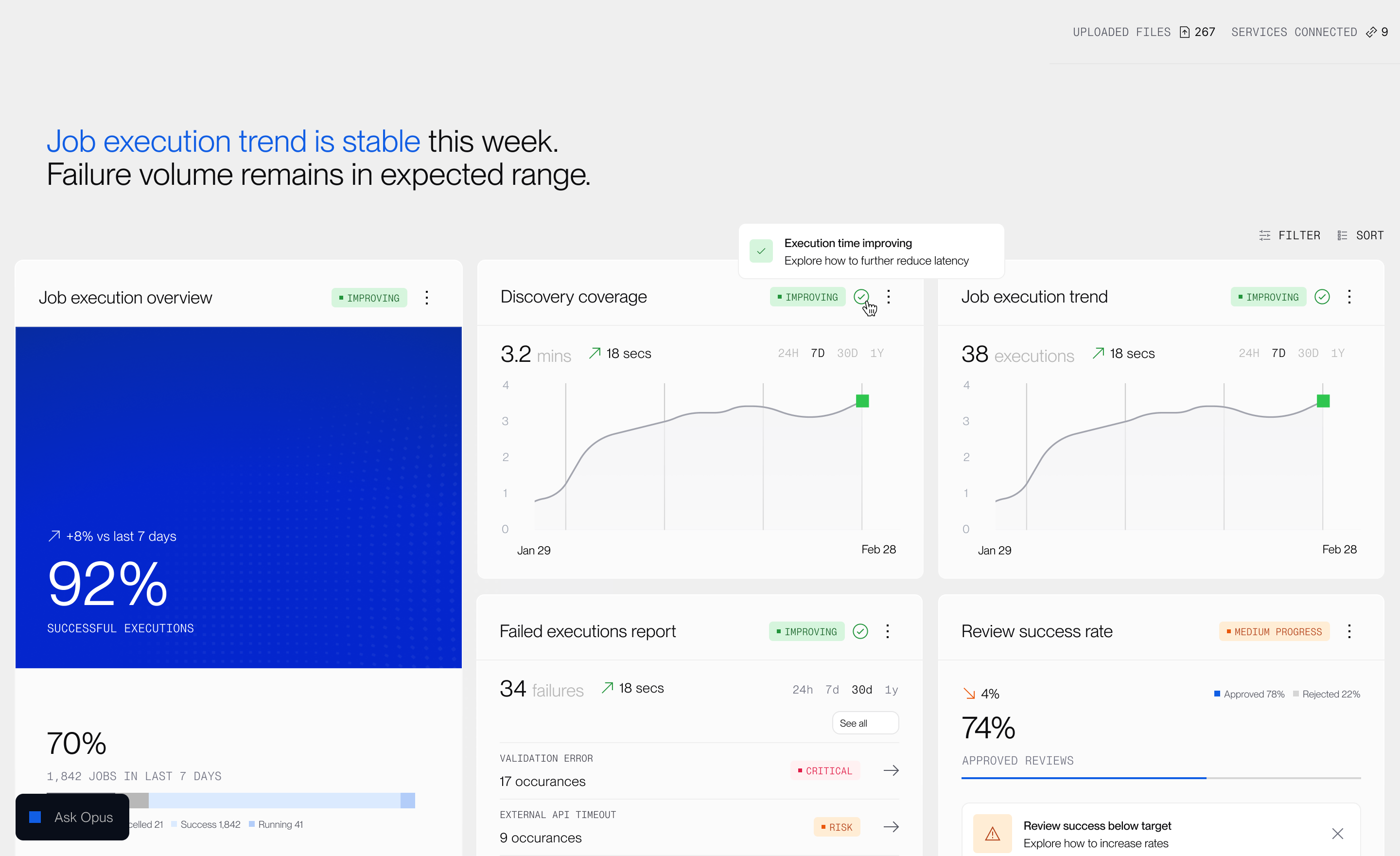
Built for sensitive access and systems data, deployable in your own cloud, private cloud, or on-prem, with every action logged and auditable.
No. Opus runs on top of your existing stack — including your ITSM — and handles the cross-system work around the ticket, not the ticketing itself. Designed to integrate, not replace.
Opus works within your existing permissions and least-privilege access, with a person on the approvals that matter and a full audit trail of every action.
No. Opus is model-agnostic — use any model, or several.
No. Start with one workflow, run it in parallel with a person in the loop, and scale once it's proven.
You do. Opus routes approvals to the right owner and logs every action, so access and provisioning decisions stay with your team.
Book a working session and we'll map one of your workflows live.