Intake & requisitions
TodayRequests arrive half-complete and get routed by hand.
OpusStructures each request, checks it against policy, and routes it to the right buyer.

Opus builds a live model of how procurement really runs: your Digital Twin, built with your teams, not process docs. Then it puts AI to work where the savings are, with a person on the approvals that matter.

Some examples of the high-volume, repetitive workflows teams hand to Opus, across sourcing, buying and supplier management.
TodayRequests arrive half-complete and get routed by hand.
OpusStructures each request, checks it against policy, and routes it to the right buyer.
TodayVendor documents collected and checked manually, slow to activate.
OpusCollects and validates vendor documents, and flags risks before a supplier goes live.
TodayContracts read clause by clause against the playbook.
OpusExtracts key clauses, flags deviations from your standards, and summarises them for sign-off.
TodayBids compared by hand in spreadsheets.
OpusScores bids against your criteria and compiles an award recommendation for review.
TodayInvoices matched to POs and receipts by hand, exceptions pile up.
OpusMatches invoices to POs and receipts, and routes discrepancies for sign-off before payment.
TodaySupplier risk tracked reactively, across scattered sources.
OpusPulls risk and performance data across sources, and flags what needs review.
Procurement's time gets swallowed by repetitive, manual work: chasing requests, checking documents, matching invoices across systems that don't connect. So the sourcing and strategy that create real value keep getting pushed back. You know AI could take some of the load, but not which parts, what it's worth, or whether it's safe to change. That's where Opus comes in.
See the work as it really runs, and know the value of a change before you make it.
Opus redesigns it for AI first, then runs the better version, so you're improving the work, not just speeding up a flawed one. A person stays on the approvals that matter, and it keeps learning after go-live.
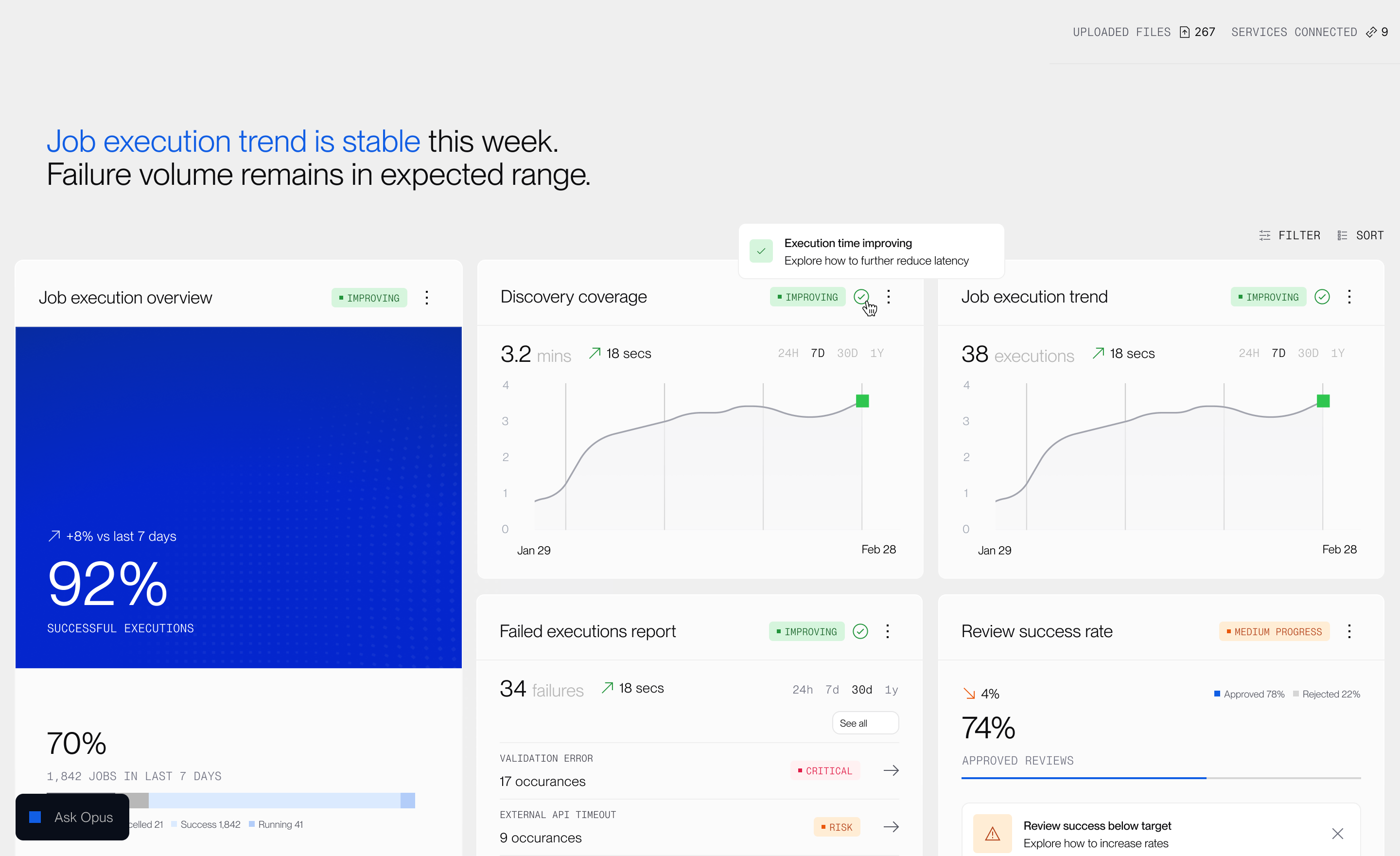
Built for sensitive supplier, contract and spend data, deployable in your own cloud, private cloud, or on-prem, with every action logged and auditable.
No. Opus is an operating layer on top of your existing stack — your procurement platform, ERP and the rest — designed to integrate, not replace.
Yes. Opus works within your existing policies, approval thresholds and delegation of authority — a person stays on the approvals that matter, with a full audit trail.
No. Opus is model-agnostic — use any model, or several.
No. Start with one workflow, run it in parallel with a person in the loop, and scale once it's proven.
You do. Opus routes exceptions and recommendations to your team and logs every step, so supplier, award and spend decisions stay with your people.
Book a working session and we'll map one of your workflows live.